Each connected system keeps its authority. Apyrn registers the approved operations against it and nothing more.
Result and contract
- Approved operations
- Read and write, per system
- Registered
Apyrn One Cloud
Connect the systems you already run, unify the customer, product, order, stock, and invoice records inside them, and publish governed APIs and MCP tools for your applications and AI agents — on infrastructure Apyrn operates.
A multi-branch retailer connects Shopify, Stripe, and an internal warehouse, then serves one Customer360 contract to its storefront, its analytics, and its support agent.
Apyrn One Cloud
Walk the four steps a Cloud workspace takes to turn systems you already run into a contract an application or an agent can call.
Select a step to see what your team configures and what Apyrn operates.
Each connected system keeps its authority. Apyrn registers the approved operations against it and nothing more.
Result and contract
One customer and one order read consistently once the fields that carry the same meaning across systems are mapped to one contract.
Result and contract
The API product carries ownership, versions, and policy at its boundary, so a consumer never depends on a source schema directly.
Result and contract
Published API products are exposed through the MCP server with OAuth 2.1, scoped per workspace, so an agent never holds credentials for an underlying system.
Result and contract
Guided explanation
The customer problem
Teams need unified customer, product, order, stock, and invoice records from the systems they already run, without standing up and operating the platform themselves.
The better operating model
Apyrn One Cloud is the SaaS edition. Apyrn operates the gateway, the connectors, and the synchronization; your team configures connected systems, workspaces, API products, and agent access.
The solution approach
Start from the records a consumer needs, connect the systems that own them, then publish the APIs and MCP tools approved consumers use.
Conceptual architecture
Apyrn operates the Apyrn One gateway, the connectors, and scheduled synchronization.
Connected systems remain the systems of record; Cloud reads and writes through approved operations.
Webhook events are captured, retried, and replayable with delivery history.
Agent access is issued through the MCP server using OAuth 2.1, scoped per workspace.
Enterprise examples
A multi-branch retailer unifies customer and order records across Shopify, Stripe, and an internal warehouse.
An AI-agent company gives each end customer its own workspace and a sandbox to test against first.
An operations team replays a batch of failed webhook deliveries after a provider outage.
What this enables
Publish stable business APIs over connected systems without operating the platform yourself.
Give AI agents governed access through MCP instead of credentials for each underlying system.
Keep delivery history, audit export, and per-workspace scope available to approved administrators.
Scope and qualification
The Business and Agent Partner plans differ in connected systems, workspaces, API call allowance, and agent access.
Systems outside the published connector list are reached through their own APIs rather than a packaged connector.
Who runs what
Apyrn runs the gateway, the connectors, and the scheduled synchronization, and keeps them patched. Your team decides which systems are connected, which API products are published, which workspaces exist, and which agents may call them.
Two plans
Business is for companies unifying their own operations. Agent Partner is for companies whose product is an AI agent serving their own end customers.
Up to 10 connected systems, synchronized every 15 minutes, with unified records across them. Three workspaces, 25 users, SSO, and audit export. Unlimited API products with 1 million calls included, 10 agents through the MCP server, and alerting on sync and delivery failures.
For multi-branch and multi-brand companiesA separate workspace for each of your end customers, 10 included, with up to 5 connected systems each and a sandbox to test against. 2 million API calls included, unlimited agents through the MCP server, MCP server generation for published API products, and a named contact at Apyrn.
For AI-agent companies serving end customersThe allowances above are what each plan includes. Talk to us if your volumes are higher.
Included in both plans
Inbound webhook events are captured with their delivery history, retried when a receiver is not ready, and replayable after an outage.
Published API products are exposed to agents through the MCP server, authorized with OAuth 2.1 and scoped per workspace, instead of handing agents credentials for each underlying system.
Enterprise identity integration for your own users, with an audit export approved administrators can pull.
Alerts on synchronization and delivery failures, so a broken connector surfaces before a consumer notices.
How the plans are measured
One connected system is one system Apyrn reads from or writes to. Systems with a packaged connector and systems reached through their own API both count.
Business 10 · Agent Partner 5 per workspaceThe included call volume covers every consumer of your published API products together — applications, analytics, partners, and agents.
Business 1 million · Agent Partner 2 millionA workspace is an isolated set of connected systems, API products, and users. Business uses them to separate brands or regions; Agent Partner uses one per end customer.
Business 3 · Agent Partner 10 includedAn agent is one MCP client authorized against your published API products, scoped to a workspace with OAuth 2.1.
Business 10 · Agent Partner unlimitedGetting started
Register the systems that own the records you need, with the operations each one approves. Connected systems stay the systems of record.
Map the fields that mean the same thing across those systems, so one customer or one order reads consistently.
Publish the contract consumers use, with ownership, versions, and policy attached at the product boundary.
Give applications, analytics, and agents access to the published product — agents through the MCP server, scoped to their workspace.
How it fits together
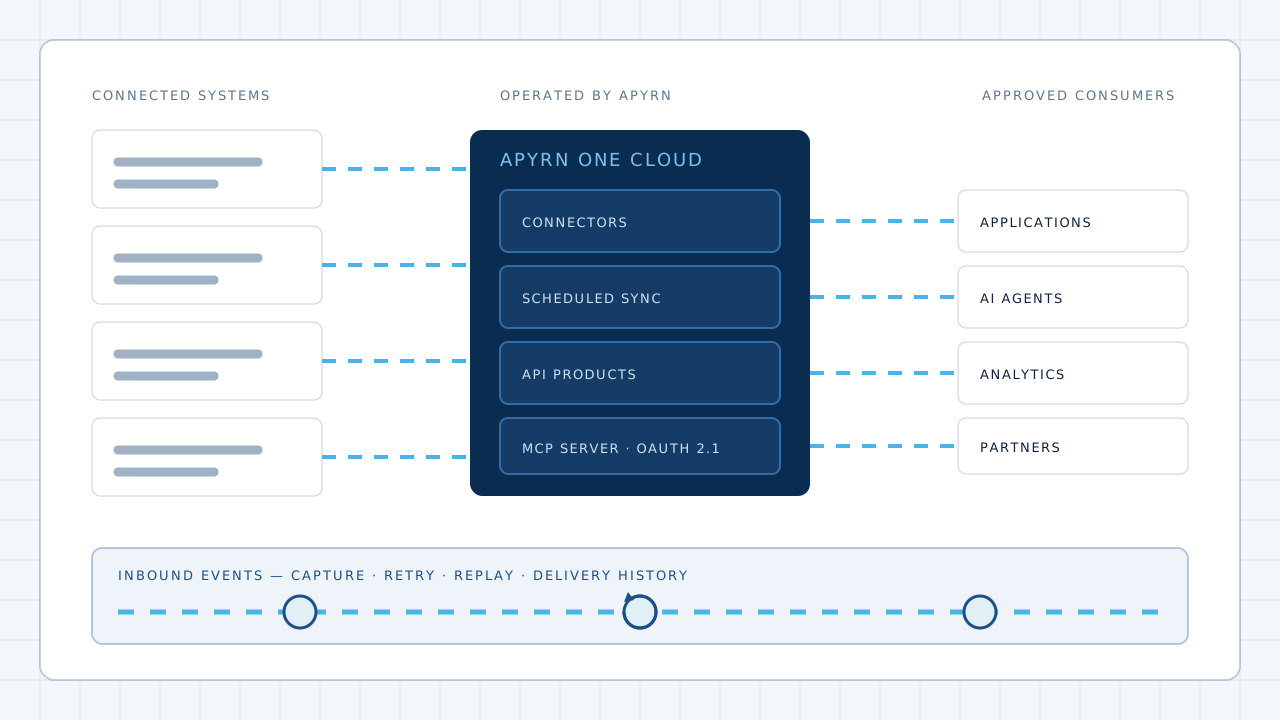
Apyrn operates the connectors, the scheduled synchronization, and the gateway between your systems of record and the applications, agents, analytics, and partners that consume what you publish. Inbound events are captured with their delivery history so a failed delivery can be retried or replayed.
Apyrn provides packaged connectors for the systems on the connectors page. Anything outside that list is reached through its own API.
Tell us which systems you need connected and which consumers need serving, and we will set up the workspace with you.