Apyrn One installs and upgrades through Helm, so the version that runs and the moment it lands are both your team's decision.
Result and contract
- Upgrade timing
- Chosen by your team
- Controlled
Apyrn One Enterprise
Apyrn One turns your ERP, CRM, and database systems into governed APIs and agent tools. Enterprise installs it in your infrastructure with Helm, keeps the encryption keys with you, and runs on an offline licence where sites have no outbound connectivity.
A manufacturer runs the control plane inside a plant network with no outbound connectivity, on an offline licence, with its own keys.
Apyrn One Enterprise
Four things change when you operate the environment yourself — where it installs, who holds the keys, which sites can run disconnected, and who reviews a change before it lands.
Select a concern to see where the responsibility sits.
Apyrn One installs and upgrades through Helm, so the version that runs and the moment it lands are both your team's decision.
Result and contract
Customer-managed keys mean Apyrn does not hold them, which is what key-custody requirements usually turn on.
Result and contract
Offline licences validate without calling out, so a plant network or a restricted site runs the same software as the connected estate.
Result and contract
The estate and context graph records systems, dependencies, and the impact of a proposed change, so a decision is made on evidence and stays auditable afterwards.
Result and contract
Guided explanation
The customer problem
Regulated, disconnected, and air-gapped enterprises need the control plane inside their own boundary, with their own key custody and their own upgrade process.
The better operating model
Apyrn One Enterprise installs into the customer environment with Helm, uses customer-managed keys, and supports offline licensing for sites with no outbound connectivity.
The solution approach
Map the estate, review the impact of a proposed change, record the decision, then install and operate inside your own boundary.
Conceptual architecture
Installs into the customer environment with Helm; the customer controls upgrade timing.
Customer-managed keys, so encryption keys stay in the customer's custody.
Offline licences support disconnected and air-gapped installations.
The estate and context graph records systems, dependencies, and the impact of a proposed change for review.
Enterprise examples
A manufacturer runs the control plane inside a plant network with no outbound connectivity.
An architecture team reviews the impact of retiring a system before approving the change.
A group compares two estates while integrating an acquisition.
What this enables
Keep the control plane, its data path, and its keys inside your own environment.
Review the impact of a modernization decision before committing to it.
Operate the same API products and Business APIs as the hosted edition.
Scope and qualification
Deployment topology, identity path, and operational responsibility are confirmed for each installation.
The customer operates the environment; Apyrn provides the software, upgrades, and support.
Where it runs
Apyrn One Enterprise installs into your own environment. Apyrn provides the software, the upgrades, and support; your team operates the environment, holds the encryption keys, and decides when an upgrade happens.
Installation and custody
Install and upgrade through Helm into your own cluster, on your schedule rather than ours.
Encryption keys stay in your custody. Apyrn does not hold them.
Licences that validate without calling out, so disconnected and air-gapped sites can run the same software.
Run connected and disconnected sites against the same published API products, with the topology confirmed for each installation.
Understanding the estate
Record the systems in the estate, what depends on what, and the business meaning attached to each, as reviewed evidence rather than a guess.
See what a proposed change touches — which consumers, which contracts, which downstream systems — before approving it.
Record the modernization decision, who approved it, and on what evidence, so the decision is auditable later.
Compare two estates side by side, which is what an acquisition or a group consolidation actually requires.
How it fits together
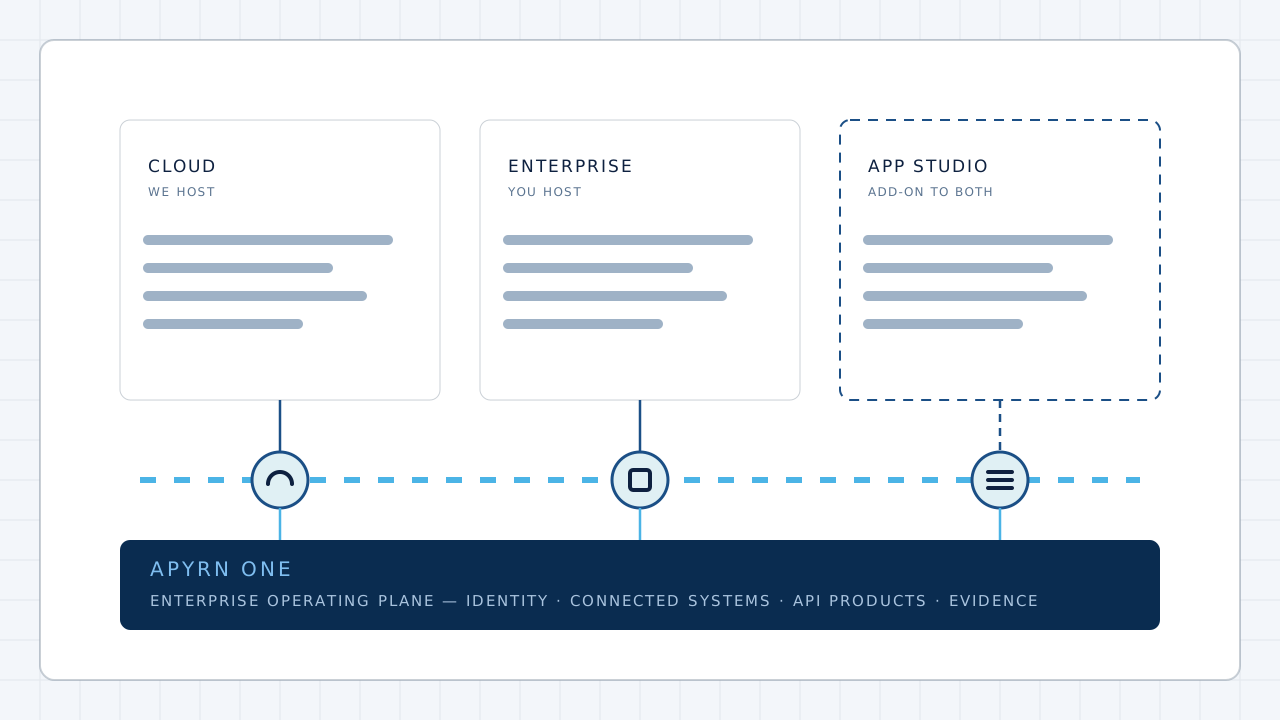
Apyrn One carries both editions. The difference is which side of your boundary the environment sits on, who holds the encryption keys, and who decides when an upgrade happens. App Studio attaches to either one.
Operating foundations
Define ownership, lifecycle, version, policy, approval, and consumer boundaries for every API product.
Design least-privilege source access, consumer authorization, data boundaries, and policy enforcement into API products.
See API product health, source dependencies, consumer usage, policy outcomes, provenance, and change impact.
The five Apyrn One capabilities, the six Business API accelerators, and the solution journeys apply whichever edition you run.
The conversation starts with your deployment topology, your identity path, your key custody requirements, and whether any site needs to run offline.